
Build stronger thinking from the ground up.
An IMPERATIVE for teaching in the Age of AI.

As schools try and figure out when to invite AI into learning and when to forbid it, let’s return to ancient architecture and the strongest geometric shape: the triangle.
Many have pointed out that the advent of AI spotlights existing weaknesses in educational norms, so as we consider how and when to thoughtfully integrate AI—and how to prevent it from robbing us of opportunities to think—let’s consider a triangular foundation of imperatives to work on consistently, no matter our teaching circumstances or opinions on artificial intelligence. (And yes, those em dashes are mine. This post is human-crafted with one AI-generated image.)
We can work on these within the classroom, the department, the district, and the system. These three actions empower us and afford each of us agency for whatever is ahead.
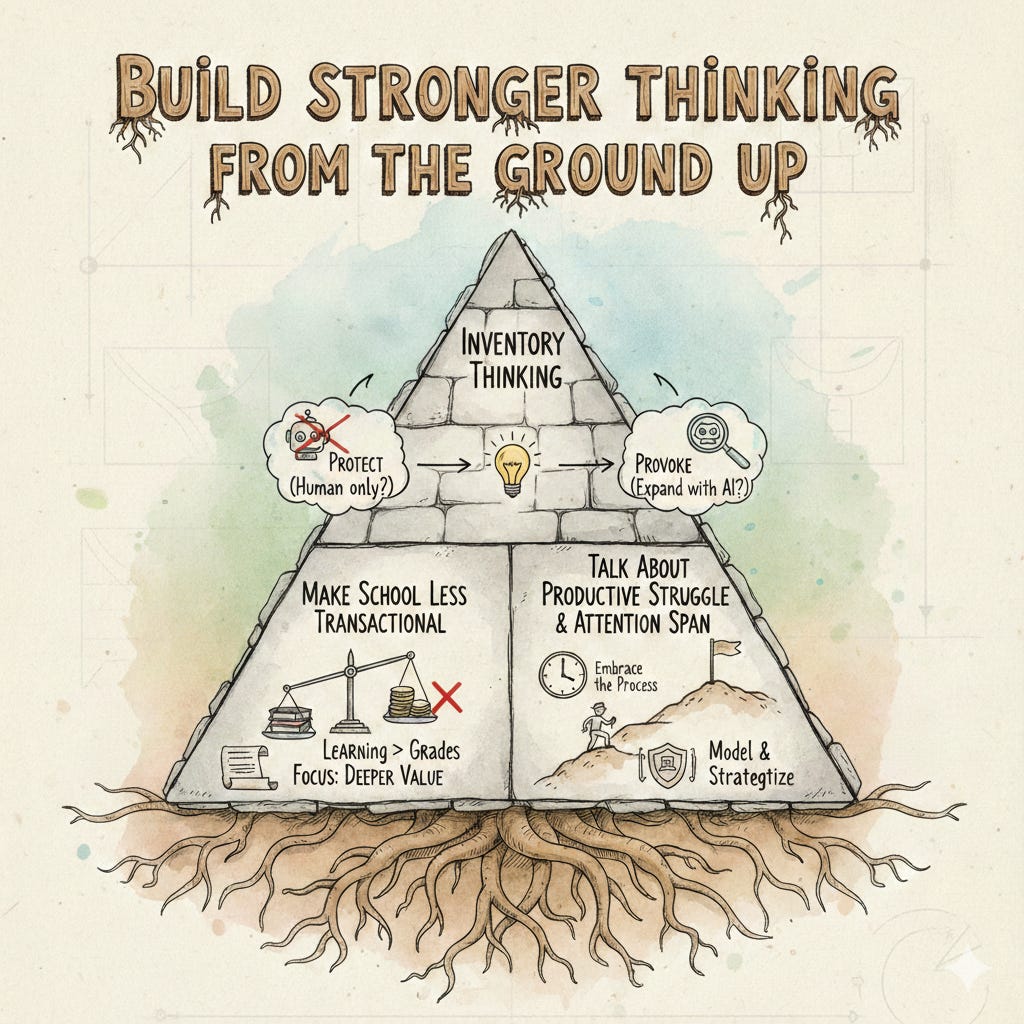
Pinpoint the Epicenters of Critical Thinking
Excellent teachers who rail against the intrusion of AI in school often cite critical thinking as the most at-risk skill in the classroom. I agree.
But the more arguments I hear about endangered critical thinking, the more I think we easily inflate our perceptions of how much critical thinking goes on any given day, even in effective classrooms.
The five-paragraph essay and the textbook activity and the standardized test prep drill are sure not inviting it. And even in classrooms that do not center these types of things, some days are about building knowledge or practicing a skill.
So what if each teacher, with course-alike colleagues, takes some time to identify where they feel the epicenters of critical thinking exist in their current courses and practices. Then ask two questions:
1. Do we need to keep AI out of the mix to protect and preserve critical thinking that is purely human in this learning activity?
Or . . .
2. Can we invite AI into the mix to provoke and expand critical thinking in this learning activity?
The answers to those two questions will likely vary based on the nature and objective of the activity, as well as how the particular teacher employs their well-honed art of teaching in the classroom.
Engaging students in thinking or notebook writing about how or why AI would endanger or enhance critical thinking for a particular experience or unit or course is also a valuable exercise in thinking critically about artificial intelligence – a skill we should all be developing.
Make School Less Transactional
When students (and parents, if we’re being honest) see school only in terms of grades and GPA, they shortchange themselves of the deeper value of learning and becoming a well-educated person.
This has been problematic long before AI entered the scene. It’s just cringingly apparent right now.
A student who worships grades will be much more likely to sacrifice their own integrity on the altar of points whether that means peeking off a neighbor’s exam or having a chatbot compose the essay or empowering an AI agent to take a quiz for them on an LMS.
Report cards are not receipts.
Graduation ceremonies are not checkout counters.
Learning is an endeavor filled with frustration and with joy.
Do we talk about all of this with kids? Does our storytelling embed these truths? Do we help students weigh how they value grades against how they value learning?
We always should have been, but we need this now more than ever.
Changing the grading system becomes more urgent when the traditional numbers-and-letters currency of the school makes friction and struggle in our learning seem too risky.
But even teachers like me, working within a traditional grading system, have power to shift value away from numbers in several ways:
Embed feedback loops on formative work in our daily practice; make sure that most feedback comes during, not at the end, of a project.
Allow students to “pitch” grades on some aspects of their graded work, synthesizing and articulating the evidence to support their pitch.
Weed out gradebook items that are based on compliance or conformity and are not evidence of student skill development and/or mastery of skills.
Afford opportunities for learning that are driven by student curiosity and not tied to grades at all.
Talk About Productive Struggle and Attention Span
If your doctor sees numbers they don’t like in your blood test results, we don’t expect them to click their tongues sadly and say, “Wow, I don’t like these numbers,” and walk away in judgmental forfeit. We expect clear, professional advice about what we can do to correct course.
But sometimes, venting in the teacher’s lounge, all we do is wag our heads in chagrin and talk behind our students’ backs about their phone addictions and lax attention spans.
To be fair, not much professional development has equipped us to give kids strategies to change these trajectories, and while laws banning cell phones at school send a message, they don’t fundamentally shift a cultural trend that devalues and erodes our sustained attention.
But what if we bring it up more often?
Teachers are good storytellers.
Can we embed stories of how productive struggle and sustained attention has been meaningful in our own lives and skill development, linking it to the content we teach?
Can we link these skills to something we love outside of school: hunting, woodworking, crocheting, hiking, Disney vacation planning?
Can we emphasize these qualities as we study characters and scientists and historical figures across the curriculum? How do their productive struggles and sustained attention pay off?
As adults living in the twenty-first century, we probably struggle with attention span issues as well. What are we doing about it?
Can we model what it means to be responsive to the bad habits we might see developing in ourselves?
Can we talk about what we do when we find ourselves too addicted to technology?
Can we invite students to write reflections or action plans or solutions they have researched that directly address their attention spans?
Forward momentum in developing skills we want our students to value fosters more optimism than decrying the skills they have not yet developed. And some of those skills are more fundamental than they used to be, even for teenagers: working through a tough spot, paying attention to little things.
Check out these articles about how to help kids value productive struggle and extend their attention spans and manage distraction.
It Is Never Just About AI
I write about artificial intelligence and how to approach it with balance, reflection, and cautious care, working to make sure it pushes rather than evades thinking.
But none of these matters (or works very well) if we are not simultaneously working to strengthen this triangle of skills to support good human thinking, which will serve students well in any classroom and in life, in pursuits that are both analog and digital and some hybrid of the two.
All of us, no matter what our personal stance on artificial intelligence, can work on the foundational weaknesses artificial intelligence exposed in school, not simply what to do about artificial intelligence.
Let’s strengthen this triangle.
Appreciate your thoughtful approach to these questions. If you don't mind, I'd like to pick up on your discussion of critical thinking.
I'd agree that teachers sometimes invoke critical thinking as a kind of protective incantation, without being very specific or practical about where and how our students are engaging in it. In my experience, this is partly because we've learned that it can provide a useful rhetorical lever when we're engaging with external audiences. But for ourselves, and in our teaching, I'd agree that it's good to be more thoughtful - to think more critically - about what critical thinking is and how it happens in the classroom.
With that in mind, I want to respond to what you say in this paragraph:
"The five-paragraph essay and the textbook activity and the standardized test prep drill are sure not inviting it. And even in classrooms that do not center these types of things, some days are about building knowledge or practicing a skill."
Where the second sentence appears to separate critical thinking from building knowledge and practicing skills, I would argue that we should see these things as being interconnected and work to make them *more* interconnected for our students. (And I would add, more interconnected with creative thinking as well.)
I also want to think about *why* things like standard five-paragraph essays, textbook activities, and prep drills fail to encourage critical thinking. I'd suggest that this has to do with the degree to which these practices impose an unquestioned apparatus that displaces and suppresses student thinking. Instead of thinking through the shape of their own thoughts, students are told that their essays should have five paragraphs. Instead of thinking about the questions they want to ask, students are provided with a set of questions that they are required to answer, often provided with the answers they are permitted to give, and frequently told that only one answer is correct. Etc.
I'd argue that consumer AI tools function as this kind of unquestioned apparatus. Human thinking is displaced into the system, which is to a very great degree a black box from the perspective of the person using it. To think critically about the output of the system, it's necessary to engage *adversarially* with the corporate project of generative AI, which is in many ways deeply antagonistic to critical thinking and human creativity (in addition to its other social and environmental costs).
Given the state of the world we live in, I think there's an argument to be made that this kind of critical engagement is a necessary part of our work as English teachers. (Though I think there's also an argument to be made that given the state of the world, it's all the more important to create a space for distinctly human learning and creativity.) But to be clear, the kind of critical engagement I'm talking about is distinct from using AI as a tool. When it comes to the question of whether we can "expand critical thinking by inviting AI into the mix," my answer, when it comes to generative AI in its corporate form, would be a pretty clear no.